Mar 8, 2013

Exxon is positioned to compete in a world with diminishing resources.

by Allen Good
Morningstar's Editorial Policies

Analyst Note 03/07/13
ExxonMobil XOM held its annual analyst day Wednesday where it provided updated production guidance and shed light on what is shaping up to be a well-stocked upstream cupboard. At the same time, the firm raised its capital spending forecast in what seems like an annual tradition. Downstream operations also took center stage as Exxon highlighted its advantaged position, particularly in the United States.

After a disappointing 2012, when production fell nearly 6%, ExxonMobil expects 2013 production to fall another 1%. However, the headline number is not as negative as it appears, in our opinion, given the underlying mix change. Liquids production is expected to grow 2%, thanks in part to the Kearl oil sands project startup, while natural gas will drop 5%. The decline in natural gas volumes is in part due to natural decline in Europe, but also a result of the aggressive shift in Exxon's domestic rig count away from dry gas plays. The company previously stated it has transitioned two thirds of its rigs to liquid-rich plays. Given the low natural gas prices, the reduction in activity makes sense. The mix shift should also help address ExxonMobil's lagging earnings per barrel metric. CEO Rex Tillerson expressed frustration with the metric's deterioration over the past few years and stressed that improvement remains a focal point, even suggesting underperforming assets could be sold if management cannot identify a path to improvement.

Longer-term production guidance is for growth of 2%-3% per year for 2013-17. The growth should be driven by liquids growth of roughly 4% per year and natural gas of 1% per year. Exxon actually expects natural gas production to fall through 2014 because of the U.S. dry gas activity reduction, but to begin growing again in 2015 thanks to the addition of liquid natural gas projects in Australia and Papua New Guinea. As a result, liquids-price-linked production is expected to grow 3%-4% per year. Also, Exxon now expects capital spending to average $38 billion per year excluding acquisitions through 2017, compared with guidance of $37 billion (2012-16) previously. We plan to incorporate all the new guidance into our forecast, but do not expect a change to our fair value estimate or moat rating.

Thesis 12/06/12
ExxonMobil sets itself apart from the other majors as a superior capital allocator and operator. Through a relentless pursuit of efficiency, technology, development, and operational improvement, it consistently delivers higher returns on capital relative to peers. However, we think ongoing low U.S. natural gas prices are likely to prove a drag on returns, which could fall behind those of more oil-exposed peers. 

Longer term, we think Exxon will probably retain its top spot, but delivering returns on par with historical levels could be more difficult as it faces the ongoing challenge of reserve replacement. With a majority of the world's remaining resources in government hands, opportunities for the company to expand its large production base are limited. However, we believe Exxon's experience and expertise, particularly with large projects, should allow it to successfully compete for resources.

While we believe Exxon has an advantage in the current environment, that does not necessarily mean production and reserve gains will come easily or cheaply. Exxon's need for projects of a certain size in order to contribute meaningfully to its production profile and justify investment leaves it with an diminishing set of opportunities. In addition, investing exclusively in large projects exposes the company to a variety of risks including overinvestment risk, execution risk, and budgetary risk. Future projects will also probably rely on resources with higher extraction costs because of their lower quality (bitumen), location (deeper water) or stimulation requirement (fracturing).

Greater competition is also becoming an issue. Many available large projects will be done in partnership with national oil companies. To gain access, Exxon must not only demonstrate its value but may also have to agree to production-sharing agreements that are not as advantageous as in the past. More often, management is faced with a tough decision: Take less favorable terms on more projects, or focus on projects where its expertise is highly valued. A good example of the latter case is Exxon's recent deal with Rosneft to explore for oil in the Russian Arctic. If Exxon is able to exploit similar opportunities where it can add oil reserves with attractive terms thanks to its value proposition, then it can probably continue to deliver superior returns on capital.

Faced with these challenges, Exxon is turning to relative political safe havens to drive growth like the United States and Canada. In the U.S., growth will largely come from resources added with the acquisition of XTO. While the acquisition largely consisted of natural gas reserves and production, it also held acreage in tight oil plays to which Exxon has subsequently added, namely in the Bakken and Duvernay. It is now also shifting its drilling activities to these more liquid-rich plays in light of low prices. Exxon has cut its rig count to 50 from 70 last year and is using two thirds of those rigs in liquid-rich plays as opposed to less than half previously. That said, we still expect returns to suffer as low prices depress profits and shale gas invested capital sits idle.

Exxon also has promising offshore discoveries in the Gulf of Mexico that should be developed in the coming years. In Canada, Exxon's reserves are primarily oil sands, both mining and in situ. Its largest project, Kearl, will come on line in late 2012. While Kearl initially will add about 100 thousand barrels a day of oil production, oil sands mining projects typically fall on the upper end of the cost curve. We think Kearl is better positioned than other projects because it does not require an upgrader, but it still is indicative of the move to higher-cost resources by Exxon in the face of increased resource nationalism.

Another way Exxon is tackling its growth/reserve replacement issues is by investing in projects like oil sands and LNG that produce at plateau production levels for longer than traditional projects, some up to decades, and reduce its overall decline rates. Also, relatively little reinvestment is required after the large initial up-front capital, resulting in significant free cash flow generation after startup. We estimate nearly 40% of Exxon's production will come from these types of projects by 2016. However, most are large projects, especially the LNG developments, and thus hold the aforementioned risks.

Despite growing investment in the U.S., Exxon is not stepping off the international stage or away from political risk. Asia and Africa continue to be the company's largest producing regions and we expect them to continue as such, with numerous projects scheduled to come on line over the next five years in Nigeria, Angola, and Kazakhstan. Exxon also has the potential for shale resources in Europe and South America that would allow it to leverage its acquired unconventional technology and bolster its value proposition and competitive advantage in the global competition for resources.
We are maintaining our fair value estimate of $91 per share after lowering our long-term natural gas price assumption from $6.50 per thousand cubic feet to $5.40. The lower natural gas prices reduces our fair value by $5, all else equal. However, the reduction is largely offset by the rise in short-term oil prices since our last update. Our long-term forecasts and assumptions incorporate a more challenging operating environment as well as a decline in returns on capital relative to historical performance over our forecast period.

Our fair value estimate is approximately 4.9 times our 2013 EBITDA estimate of $86 billion. In our discounted cash flow model, our benchmark oil and gas prices are based on Nymex futures contracts for 2012-14. For natural gas, we use $2.87/mcf in 2012, $4.08 in 2013, and $4.08 in 2014. Our long-term natural gas price assumptions for 2015 and 2016 are $5.40. For oil, we use Brent prices of $112 per barrel in 2012, $108 in 2013, and $104 in 2014. Our long-term oil price assumptions for 2015 and 2016 are $99 and $102, respectively. We assume a cost of equity of 8%.

We forecast a compound annual growth rate for production of 1.1% during our forecast period. Growth should be more robust in outer years after falling approximately 3% in 2012. We expect Exxon to actually increase oil volumes (1.8%) at a greater rate than natural gas (0.4%) over our forecast period thanks to large project startups over the next three years. Our forecast is slightly below management's forecast to compensate for the potential negative effects of higher oil prices related to production-sharing contracts as well as the risk associated with larger projects. Full realization of management's guidance could offer upside to our valuation, while extensive delays or reduced U.S. natural gas production due to lower prices could result in downside risk.

Refining margins have staged a recovery in the past year. However, we model slight margin weakness over the next couple of years with an improvement in the later years of our forecast. While ExxonMobil should benefit from highly complex facilities and access to growth markets, it has only limited exposure to wide U.S. domestic sweet crude discounts. However, that should change in the future as additional pipeline capacity brings domestic and Canadian crude to the Gulf Coast, improving ExxonMobil's access to discount feedstock. Meanwhile, we anticipate chemical earnings to remain tied to economic activity.
For a company with global operations, geopolitical risk is always an issue. Past events in Russia, Nigeria, and Venezuela underscore the risk associated with doing business in those countries. These risks will only become greater as Exxon expands its global production portfolio through partnerships with NOCs. By investing in large, capital-intensive projects, Exxon also runs the risk that commodity prices will decrease dramatically, making those projects no longer economical. Deterioration of refining fundamentals in the U.S. and Europe may continue to damage profitability long after an economic recovery.

Management & Stewardship
Rex Tillerson became chairman and CEO in 2006. Previously, he served as president. He has spent his career with Exxon, beginning in 1975 as a production engineer. The recent acquisition of XTO Energy raised concerns that he may be straying from the returns-focused strategy that has made ExxonMobil great and instead investing in growth for the sake of growth. ExxonMobil's subsequent performance has lent weight to this argument as gas volumes have grown while prices have fallen, resulting in declining returns. However, while the acquisition has proven to be ill-timed given the drop in natural gas prices, we think ultimately it can deliver returns that meet ExxonMobil's requirements as prices rise and it leverages XTO's knowledge to exploit unconventional plays globally.

ExxonMobil's record of generating shareholder returns deserves an exemplary stewardship rating, in our opinion. Despite the XTO acquisition, we think Tillerson is likely to continue a disciplined capital allocation strategy, given his previous statements, and deliver the high returns that his predecessor did. Recent efforts to exploit more lucrative Kurdistan reserves at the risk of losing pre-existing, but likely lower-returning, Iraqi contracts provides us some evidence to his focus on returns. As a result, we are inclined to maintain the exemplary rating. 
Returns to shareholders also remain a focus, with share repurchases the primary tool used to return excess cash. However, Tillerson recently acknowledged ExxonMobil's relatively low yield and indicated higher payouts could be in the future.

Overview

As one of the few remaining firms with an AAA credit rating, ExxonMobil's financial health is beyond reproach. Cash flow from operations remains sufficient to finance capital expenditures while increasing dividend payments and buying back stock. More important, the large cash position and access to cheap debt give the company resources to make opportune acquisitions.

Profile: 
Exxon is an integrated oil and gas company that explores for, produces, and refines oil around the world. In 2011, it produced 2.4 million barrels of oil and 12.1 billion cubic feet of natural gas a day. At year-end 2011, reserves stood at 17.7 billion barrels of oil equivalent (plus 7.3 billion for equity companies), 47% of which are oil. The company is the world's largest refiner and one of the world's largest manufacturers of commodity and specialty chemicals.

Mar 4, 2013

Berkshire's 2012 Book Value Gain Falls Short of S&P 500; Buffett Still Not Open to a Dividend

By Morning Star

Wide-moat rated Berkshire Hathaway's BRK.ABRK.B fourth-quarter earnings wrapped up a year in which acquisitions and ongoing improvements in the firm's non-insurance businesses contributed to what was a year of improving results for its insurance operations. Aftertax operating earnings increased 6% year over year during the fourth quarter, contributing to a 17% increase in earnings during 2012. Including the impact from investment and derivative gains, the firm reported a 49% increase in fourth-quarter net earnings, contributing to a 45% increase in net earnings for the full year.

Berkshire's book value per Class A equivalent share at the end of 2012 was USD 114,214--up 14% year over year. While a result like that would normally be seen as a positive, it was only the ninth time in the last 48 years Berkshire's percentage increase in its book value was less than that for the S&P 500 Total Return Index. Warren Buffett did go on to note in his annual letter to shareholders that in eight of those nine years the index posted gains of more than 15%.

Berkshire closed out the fourth quarter with close to USD 47 billion in cash on its books, down from USD 48 billion at the end of the third quarter. That said, the company did spend more than USD 1 billion on share repurchases, a nearly equal amount on business acquisitions, and close to USD 3 billion on capital expenditures during the fourth quarter, so we're not going to fret too much about the decline. If anything, we've become concerned about the growing cash hoard the last couple of years.

As such, we were encouraged to see Buffett putting more money to work this year, with the Heinz HNZ deal knocking more than USD 12 billion off the total. This leaves Berkshire with about USD 15 billion in need of investment, with USD 20 billion left over as a cash backstop for the insurance operations. Forget any talk of a dividend, though, as Buffett made it clear in his letter that the priorities for cash will remain (in this order): capital expenditures, acquisitions, and share repurchases. The payment of a dividend will only be considered once it no longer makes sense for Berkshire to be putting money back into the business and the market-price premium for Berkshire's stock is too high to warrant share repurchases.

Feb 19, 2013

Bernanke's Kryptonite

by Eric Parnell

How do you stop a man from printing another $1 trillion of the global reserve currency? This is seemingly an impossible task to achieve. With inflationary pressures still subdued, the U.S. Federal Reserve remains compelled to act as aggressively as possible in an ongoing effort to jump-start the economy and bring down stubbornly high unemployment. Never mind that the $2.3 trillion already printed by the Fed since the outbreak of the financial crisis several years ago has not resulted in a sustainably strong economic recovery to this point. Perhaps another $1 trillion or more will finally do the trick. But what are the unintended consequences to these repeated and extreme actions? And what if anything can finally grab the attention of the Fed to put a stop to the money printing? Oil may ultimately prove to be the kryptonite that finally weakens the resolve of Chairman Bernanke and the Fed's printing press.

Is Inflation Really Under Control?
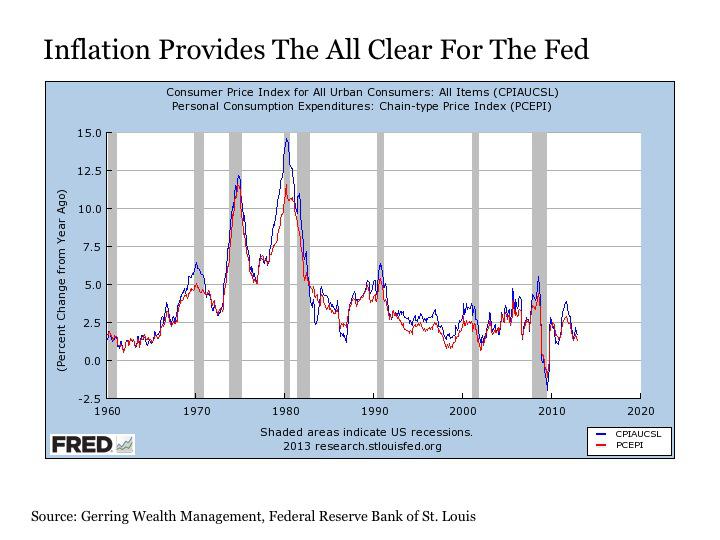
This is an important question to consider before going any further. At first glance, it appears that inflationary pressures are benign. Two well-known and widely used measures of inflation illustrate this point. These are the U.S. Consumer Price Index (CPI) reported by the Bureau of Labor Statistics (BLS) and the Personal Consumption Expenditure (PCE) price index compiled by the Bureau of Economic Analysis (BEA). Both are derived using statistical methodologies in an effort to best estimate changes in the price level of consumer goods and services over time. And an examination of both of these measures strongly suggests that inflationary pressures are under control and pricing stability reigns, with the year over year change in prices for both measures both comfortably between 1% and 2%.
(click to enlarge)
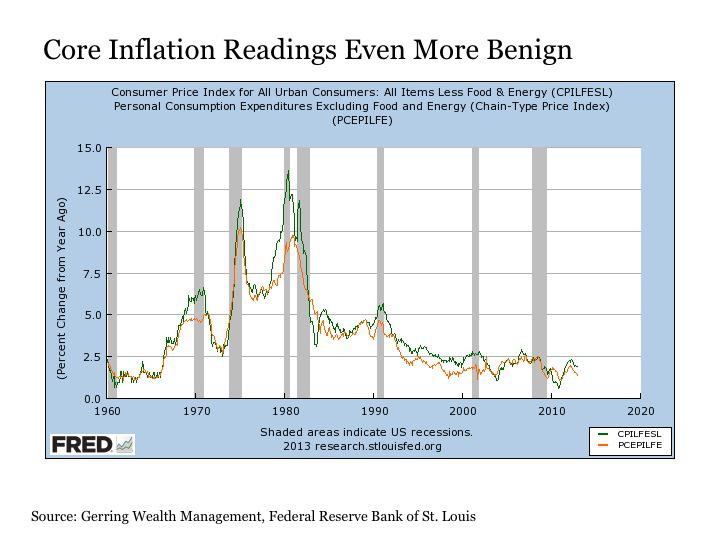
The core inflation readings that exclude the more volatile food and energy components reinforce further the idea that inflation is under control. And these core figures are particularly important for these are the readings that the Fed relies upon to monitor pricing pressures.
 
 
However, the fact that both the CPI and PCE suggest that inflation is under control does not necessarily end the discussion. It is important to note that both readings are based on statistical models that are designed to estimate changes in prices to the best of their ability. And I have no doubt that those who have constructed and are maintaining these models at the BLS and BEA are applying what they have determined to be the most statistically accurate assessments of pricing. But it is important to still point out that these are still estimations and not necessarily statements of fact. For how a model is constructed and the inputs used can lead to output that can vary widely over time.

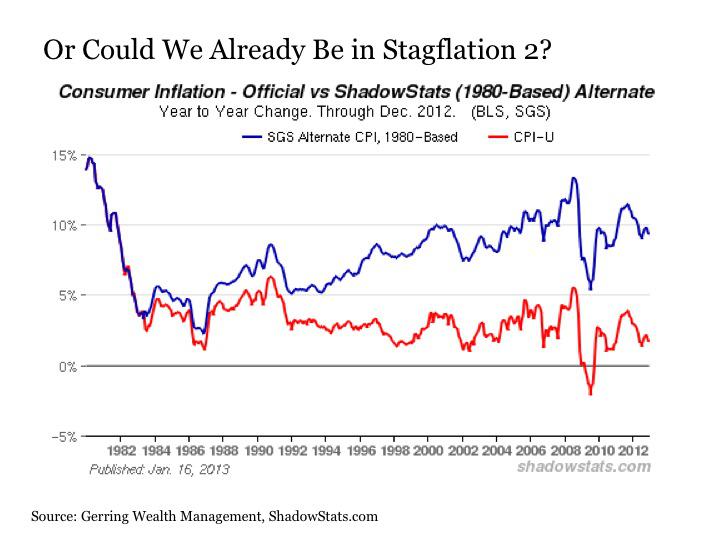
For example, John Williams at ShadowStats.com provides alternative inflation charts focusing on the CPI. Recognizing that the BLS changed their estimation methodology in both 1980 and 1990, he provides a look at how inflation would look today if these previous models were still in use. Under the pre-1990 model, inflation today would not be considered under control but instead running fairly hot at over 5%.

And under the pre-1980 model, the talk today would likely be about the return of 1970s style stagflation, not relative pricing stability.

These examples do not necessarily suggest that we have an inflation problem today. But what they do suggest is the possibility of an inflation problem that may already be lurking undetected under the surface. Of course, any conclusions about prices depend on the measuring methodology in the end.

And who among the average consumer can really argue with the Fed's conclusions about price stability anyway. Even if it feels like we may be paying much more for goods and services than we did in the past, each of us are only one in a vast population of consumers and are limited in our ability to clearly demonstrate that we actually have an inflation problem today. It's not as though we have a billboard that announces the daily price of goods and services in our economy. This is true, of course, with the exception of one key item that all Americans need to consume every single day.

What About Oil?

Let us move forward under the assumption that pricing pressures are under control, since this is what the Fed is seeing in their models. What then has the potential to rattle the Fed's cage on the inflation front whether it shows up in the official statistics or not? This product is oil. And higher prices related to oil are already arriving at a gas station near you thanks to the Fed's latest QE3 stimulus program.

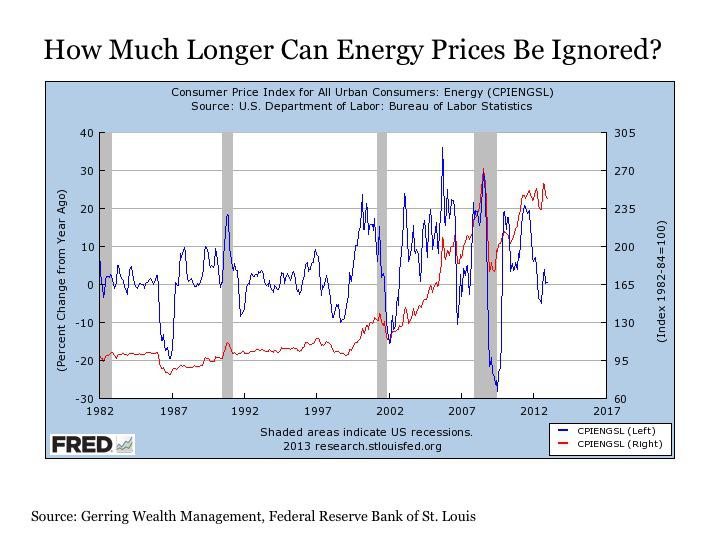
The fact that the Fed largely ignores food and energy prices in focusing on the core inflation readings instead is another subject for debate in the statistical modeling process. The justification for excluding these two items is based on the notion that both categories experience highly volatile price swings that fail to persist in a sustained price change over time. But here's the problem. Whereas price changes in these categories may not have persisted over time in the past, they have absolutely persisted over the last decade.

An examination of energy in particular highlights this point. From the early 1980s up until the year 2000, energy prices would experience wild short-term swings (the blue line on the chart above) but underlying prices would remain relatively stable (the red line on the chart above). This, of course, began changing dramatically at the start of the new millennium, as the violent price swings were not neutralizing themselves out as they had in the past but instead have been accumulating into sustained price increases at a rate of +7.5% per year on average over the last decade. Putting this in simpler terms, the price of gasoline was still consistently below $2 per gallon in the U.S. back in 2005. Eight years later in 2013, the notion of seeing gasoline below $3 per gallon seems far-fetched. And the prospects of gas prices rising sustainably past $4 per gallon or even $5 per gallon in the near-term are more than realistic.

In short, it is difficult to continue looking past food and energy prices when assessing inflation, for the increases in these categories are not only persisting but are also increasingly serving as a tax on the purchasing power of consumers.

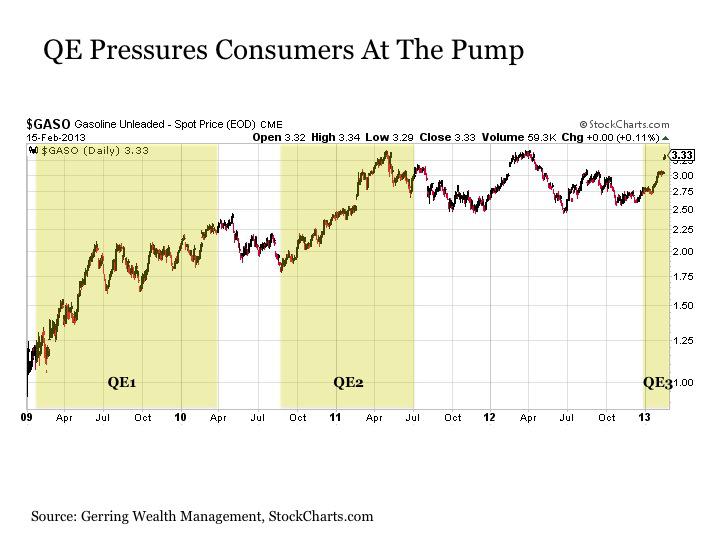
Unfortunately, the Fed is stoking the fire under energy prices with its latest QE3 stimulus program. It is not just stock prices that float higher day after day completely drunk on Fed liquidity. It is also energy prices including the staple commodities of oil and gasoline. And dating back to the beginning of the financial crisis, when the Fed has engaged in a QE stimulus program, energy prices including gasoline have floated steadily higher.

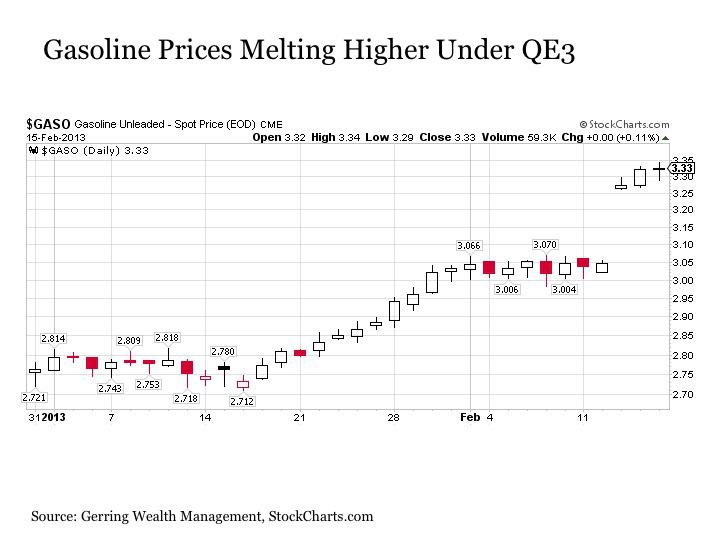
An important distinction is worth noting about QE and asset prices. It's not just any QE that gooses the prices of stocks and commodities higher. Instead, it is specifically U.S. Treasury purchases by the Fed that causes the market melt ups, for this specific strategy provides the daily injections of liquidity that float the markets higher almost daily. This is why the latest QE3 program launched in September 2012 was falling flat in asset markets until recently, for it was not until Treasury purchases commenced at the beginning of January 2013 that asset prices began steadily inflating.

Since the start of the year, the rise in gasoline prices has been both sharp and persistent. Heading into 2013, the spot price of unleaded gasoline was lingering between $2.70 and $2.80 per gallon. But once the forces of QE finally latched on to gasoline prices starting on January 17, the subsequent rise has been almost relentless. Over the past month, unleaded gasoline prices have risen in 18 out of the last 22 trading days. The cumulative effect has been a +20% rise in the spot price so far this year.

In short, the Fed's dogged efforts to try and increase stock prices for the roughly half of Americans that own stocks today according to a Gallup poll in order to create a wealth effect that just might marginally increase economic growth at some point down the road is coming at a cost of effectively taxing all Americans today who rely on gasoline to drive their cars and petroleum products to heat their homes. No wonder we have yet to see any sustained benefit to the economy from QE to date. Perhaps it is even hurting more than helping at this stage.

The Fed's Pain Threshold For Higher Gas Prices

The folks at the Fed are smart people. They have to know that QE is directly juicing not only stock prices but also energy prices including gasoline. And unlike nearly all other goods and services in our economy, the price of gasoline is one that is projected on big billboards throughout the streets of our respective towns each and every day. And while companies can narrow the width of men's ties, cut down the length of toilet paper rolls and shrink the size of popsicles in order to hide price inflation in most other parts of the economy, a gallon of gasoline is always going to be a gallon of gasoline. Thus, the price at the pump is the one key data point on inflation where there is absolutely nowhere to hide. The price of gasoline is announced loudly each and every day, and it is critical to wonder exactly what the price threshold will be when consumers begin to riot.

Looking ahead, it is highly likely that we will see $4 per gallon gasoline perhaps as early as the spring. And a run at $5 per gallon is certainly possible by the time we are in the midst of the peak summer driving season. While it is almost a given that the completely nonsensical, absolute garbage political rhetoric about greedy oil companies will return to our airwaves if and when this gasoline price rise occurs, the truth will remain that the blame for the rise in energy prices will almost entirely rest at the feet of the Fed. And whether they say so or not, they are smart enough to know that this is true.

So exactly what gasoline price point sets off public alarms remains to be seen. But it will become increasingly difficult for Fed officials to justify to the American people that we do not have an inflation problem when gas prices at the pump are screaming higher. And this will be true whether the Fed is receiving the blame for the price rise from the public or not. Whether the rising price of gasoline ultimately proves to be Bernanke's kryptonite for further QE will be a critical theme to watch as we move into the middle part of the year.

In the meantime, it is worthwhile to prepare your portfolio for such an outcome. And focusing on oil and gas stocks that are highly correlated with rising energy prices is an attractive theme. Representative names include Exxon Mobil (XOM), Chevron (CVX), Occidental Petroleum (OXY) and Apache (APA), the last of which was absolutely drubbed late last week and is now oversold on a variety of technical readings. BHP Billiton (BHP) is another attractive offering for a more diversified energy and mining allocation.

Feb 18, 2013

Berkshire Continues to Shift Cash Elsewhere

Berkshire Hathaway's BRK.ABRK.B fourth-quarter 13-F filing, which details the firm's equity holdings, continued to show evidence of the primary theme we've believed would drive portfolio movements over the near term. Ever since Berkshire appointed Ted Weschler and Todd Combs as investment managers, the firm has been fairly active about selling legacy positions as part of an ongoing process to raise capital for the two managers to invest.
 
The biggest sale during the period involved 28.8 million shares of Kraft Foods Group KRFT, which, by our estimates raised around $1.1 billion for the firm. At a little more than $75 million at the end of last year, Kraft is now one of the smallest holdings in Berkshire's equity portfolio, and we'd be surprised if the shares remained there much longer. As for the other sales during the period, Berkshire sold off another 165,000 shares of Johnson & Johnson JNJ, whittling its stake in the health-care firm down to less than $23 million at the end of the year. Much like with Kraft, we expect Johnson & Johnson to continue to be a source of cash for the managers at Berkshire. The only other sale during the fourth quarter involved Lee Enterprise LEE, which is now the smallest holding in Berkshire's equity portfolio.

Looking at the purchases during the quarter, Warren Buffett committed another $585 million to Wells Fargo WFC, which is now Berkshire's largest holding (at 20% of the total equity portfolio). DaVita DVA, General Motors GM, and DIRECTV DTV all saw more than $200 million in additional capital allocated to them as well during the period, with DaVita and DIRECTV both firmly placed as top 10 holdings at Berkshire at the end of the year. As for the other purchases during the quarter, the firm increased its stakes in IBM IBM, Wal-Mart WMT, Liberty Media LMCAV, Precision Castparts PCP, and National Oilwell Varco NOV,  but the buys were relatively small compared with Berkshire's holdings in these stocks. While there was a more meaningful purchase of Wabco Holdings WBC, and new money purchases of Archer Daniels Midland ADM and VeriSign VRSN, these transactions paled in comparison with the company's $12.2 billion investment in Heinz HNZ announced yesterday.

Berkshire Hathaway's economic moat has been built on the firm's record of acquiring and managing a portfolio of businesses with enduring competitive advantages. Whether through direct ownership of individual companies or via significant stock holdings, famed value investor Warren Buffett has typically looked to acquire firms that have consistent earnings power, generate above-average returns on capital, have little to no debt, and have solid management teams. Once purchased, these businesses tend to remain in Berkshire's portfolio, with sales occurring rarely. Buffett strives to raise capital as cheaply as possible to support Berkshire's ongoing investments and measures the success of the portfolio by per-share growth in intrinsic value. Given the current size of the firm's operations, the biggest hurdle facing Berkshire will be its ability to consistently find deals that not only add value but also are large enough to be meaningful. The other major issue facing the company is the longevity of Buffett and managing partner Charlie Munger, both of whom are octogenarians.

Berkshire's most important business continues to be its insurance operations. Not only do they contribute a meaningful amount of the firm's pre-tax earnings, but they also generate low-cost float (the temporary cash holdings arising from premiums being collected well in advance of future claims), which has been a major source of funding for investments. Berkshire underwrites insurance through three main units: GEICO, General Re, and Berkshire Hathaway Reinsurance. GEICO, the third-largest auto insurer in the United States, relies on direct selling to consumers, a model that provides it with cost advantages over some of its competitors. While this practice has become more common, GEICO was a pioneer in the channel and continues to generate solid underwriting profits and negative cost of float for Berkshire.
 
The firm's two other main insurance businesses are both reinsurers. For a premium, these subsidiaries will assume all or part of an insurance or reinsurance policy written by another insurance company. General Re is one of the largest reinsurers in the world based on premium volume and shareholder capital, while Berkshire Hathaway Reinsurance's claim to fame is its ability to take on large amounts of super-catastrophe underwriting, which covers events like terrorism and natural catastrophes. These unique policies often contain large tail risks that few companies (other than Berkshire, with its strong balance sheet) have the capacity to endure. When priced appropriately, though, these types of transactions can generate favorable long-term returns on capital for the firm.

Berkshire's non-insurance operations encompass a wide array of businesses, including Burlington Northern Santa Fe (railroad), MidAmerican Energy (energy generation and distribution), McLane (food distribution), Marmon (manufacturing), Shaw Industries (carpeting), Benjamin Moore (paint), Fruit of the Loom (apparel), Dairy Queen (restaurant), and See's Candies (food retail). Of the more than 70 non-insurance businesses in its portfolio, the two largest contributors to Berkshire's pre-tax earnings are BNSF, which the firm acquired in full in February 2010, and MidAmerican, in which Berkshire maintains a 90% stake, having initially added the company to its holdings more than a decade ago.

Buffett's shift into such debt-heavy, capital-intensive businesses as railroads and utilities is a marked departure from many of Berkshire's past investments, which have tended to require less capital investment and have had little to no debt on the books. While running railroads and utilities requires massive reinvestment, Berkshire acquired these businesses because they can earn decent returns on incremental investments, ensuring that the large amounts of cash generated by the firm's other operating businesses are reinvested in value-creating projects. And while Berkshire does consolidate the debt of these two subsidiaries on its own balance sheet, the firm guarantees none of it.

All of Berkshire's operating businesses are managed on a decentralized basis, eliminating the need for layers of management control and pushing responsibility down to the subsidiary level, where managers are empowered to make their own decisions. This leaves Buffett free to focus on capital allocation decisions and managing the investments in Berkshire's portfolio--two things that he has been extremely adept at doing over the past 40-plus years. While we could argue that Buffett is not the sole reason for Berkshire's success, he has been (and continues to be) a critical element in the firm's competitive positioning. In our view, Buffett's ultimate departure would cause the firm to lose some of the significant advantages that come from having a capital allocator of his caliber at the helm.

We've increased our fair value estimate for Berkshire Hathaway's Class B shares to $117 per share from $110 after updating our valuation model to account for changes in our assumptions about the firm's revenue, profitability, and cash flows since our last update. Our new fair value estimate is equivalent to 1.6 times Berkshire's reported book value per Class B share of $74 at the end of the third quarter of 2012 (and 1.5 times our estimate of the firm's book value at the end of 2012). During the last decade, Berkshire's Class A shares have traded in a range of 1.1-1.6 times book value, with a median value of 1.4 times.

Our fair value estimate for Berkshire is derived using a sum-of-the-parts methodology, which values the different pieces of the company's portfolio separately, then combines them to arrive at a total value for the firm. We estimate that Berkshire's insurance operations are worth $63 per Class B share, slightly higher than our previous valuation owing to our belief that premium growth and underwriting profits for the full year will come in better than we were originally forecasting. We have not, however, altered our view on the firm's investment income, which remains depressed because of the historically low-yield environment (as well as the fact that several of the high-coupon investments the firm made during the financial crisis have been, or are in the process of being, paid off).

With regard to Berkshire's non-insurance subsidiaries, we believe the manufacturing, service, and retailing operations are worth $22 per Class B share, somewhat higher than our previous estimate, owing to the ongoing improvements that continue to be seen in revenue and operating profits throughout the division, even in the face of a slow recovery in the U.S. economy. We estimate that Berkshire's railroad, utilities, and energy operations are worth $29 per Class B share, also higher than our previous forecast, due to the strength we continue to see at BNSF, as well as the ongoing operating improvements and long-term investments being made at MidAmerican. Finally, we estimate that Berkshire's finance and financial products division is worth $3 per Class B share, which is not much different from our previous forecast.

Berkshire is exposed to large potential losses through its insurance operations. While the company believes its super-catastrophe underwriting will generate solid long-term results, the volatility of this particular line of business, which can subject the firm to especially large losses, could be high. That said, Berkshire maintains much higher capital levels than almost all other insurers, which we believe helps to mitigate some of the risk. Several of the firm's key businesses--insurance, energy generation and distribution, and rail transport--operate in industries that are subject to higher degrees of regulatory oversight, which could have an impact on future business combinations and the setting of rates charged to customers. 

Berkshire also is exposed to foreign currency, equity price, and credit default risk through its various investments and operating companies. The firm's derivative contracts, in particular, can affect Berkshire's earnings and capital position, especially during volatile markets, given that they are recorded at fair value and, therefore, are periodically updated to record the changes in the value of these contracts. Many of the firm's non-insurance operations, meanwhile, are exposed to the cyclicality of the economy, with results typically suffering during economic slowdowns and recessions.

The company is also heavily dependent upon two key employees, Buffett and Munger, for almost all of its investment and capital allocation decisions. With both men now in their 80s, it has become increasingly likely that our valuation horizon will end up exceeding their expected life spans, with the expectation being that investment returns and capital-allocation quality will deteriorate under new management. The 2011 departure of David Sokol, who many had assumed would be Berkshire's next CEO, has raised serious questions as well about the firm's internal controls and, to some extent, tarnished its legacy of strong ethical behavior.

Management & Stewardship

Warren Buffett has been chairman and CEO of Berkshire Hathaway since 1970. Charlie Munger has served as vice chairman since 1978. Berkshire has two classes of common stock, with Class B shares holding 1/1,500th of the economic rights of Class A shares and only 1/10,000th of the voting rights. Buffett is Berkshire's largest shareholder, with a 34% voting stake and 22% economic interest in the firm. He has been a strong steward of investor capital, consistently aligning his own interests with those of shareholders, and Berkshire's economic moat is derived primarily from the success that he has had in melding the firm's financial strength and underwriting ability with his own investment acumen. Buffett's stewardship allowed Berkshire to increase its book value per share at a compound annual rate of 19.8% from 1965 to 2011, compared with a 9.2% total return for the S&P 500 Index.

This makes it even more important that Buffett's legacy remains intact once he no longer runs the firm. Succession was not formally addressed by Berkshire until 2005, when the firm noted that Buffett's three main jobs--chairman, chief executive, and chief investment officer--would probably be handled by one chairman (expected to be his son, Howard Buffett), one CEO (with one candidate already identified but not revealed), and three or more external hires (reporting to directly to the CEO) to manage the investment portfolio. In our view, whoever steps into Buffett's role as chief executive is going to feel more pressure from shareholders and analysts than Buffett has ever been subjected to. As such, the real long-term question for investors is whether or not the individual that succeeds him can replace the significant advantages that have come from having an investor of Buffett's caliber, with the knowledge and connections he has acquired over the years, running the show.

Overview


Berkshire's financial strength was tested by the collapse of the credit and equity markets in 2008, which ultimately led to the company losing its AAA credit rating in 2009. That said, Berkshire remains one of the most financially sound companies we cover, with the firm managing its risk through diversification and a conservative capital position. While Berkshire does not pay a dividend, the firm did initiate a share-repurchase program during the third quarter of 2011 that allowed management to buy back both Class A and Class B shares at prices no higher than a 10% premium to the firm's most recently reported book value per share. Berkshire altered the terms of the share-repurchase program during the fourth quarter of 2012, with the board now authorizing the firm to repurchase Class A and Class B shares at prices no higher than a 20% premium to the firm's most recently reported book value per share (which stood at $111,718 per Class A share, and $74 per Class B share, at the end of the third quarter of 2012).

Profile: 

Berkshire Hathaway is a holding company with a wide collection of subsidiaries engaged in a number of diverse business activities. The firm's core business is insurance, run primarily through GEICO (auto insurance), General Re (reinsurance), Berkshire Hathaway Reinsurance, and Berkshire Hathaway Primary Group. The company's other businesses are a collection of finance, manufacturing, and retailing operations, along with railroads, utilities, and energy distributors.

Feb 15, 2013

Berkshire's Ore-Right buyout is a fantastic deal for Heinz shareholders.

by Erin Lash, CFA
Authors can be reached at Analyst Feedback
Morningstar's Editorial Policies

Thesis 02/14/13

We've long believed that Heinz is well positioned for the long term thanks to its solid brand portfolio and expansive global sales and distribution network, and it appears that others share our view, as the firm is now set to be acquired by Berkshire Hathaway BRK.A  BRK.B and 3G Capital. The $28 billion deal values the packaged food firm around 12 times our fiscal 2014 adjusted EBITDA estimate, which is roughly in line with comparable multiples in the consumer product category over the recent past. Despite intense competitive pressures and rampant input cost inflation, Heinz has waded through the current operating environment relatively unscathed, and we think its competitive advantages should enable it to generate strong cash flows and returns for shareholders over the longer term.

Above anything else, Heinz is known for its ketchup. However, its products span several categories beyond the condiment aisle, including sauces, soups, baked beans, baby food, and frozen foods. While the namesake brand (which accounts for nearly 40% of the firm's annual sales) possesses significant brand equity, the portfolio has another 15 brands that generate more than $100 million in sales annually. In our view, Heinz is committed to enhancing its brand equity by continuing to invest in marketing for core brands, which currently represent about $300 million or nearly 2.5% of sales.

Although Heinz is the most globally diversified domestically based packaged food firm (with total non-U.S. revenue accounting for 60% of the consolidated total), management still believes there is room for further expansion, and we agree. For instance, Heinz is squarely focused on building out its distribution network by expanding in developing markets. The firm has launched an infant formula product line in China, a region ripe for growth, and recently announced acquisitions in China and Brazil. We believe gaining entry into these regions by acquiring local firms that are familiar with tastes and preferences in their home markets is a wise investment, and from our perspective, these initiatives won't saddle Heinz with additional debt, as ample cash generation--free cash flow amounted to more than 9% of sales in fiscal 2012, which ended in April--will enable the firm to pursue more deals around the world. Emerging markets account for about one fifth of consolidated sales, and through a combination of internal growth (like expanding the launch of infant formula) and additional acquisitions, management is targeting that sales from these high-growth markets will account for around 30% of total sales by fiscal 2016, which appears achievable to us. In fact, under the ownership of 3G (which already operates with a global portfolio of companies), more aggressive expansion in emerging markets could now be in the cards, in our view.

Commodity cost inflation (particularly for resins, sweeteners, beans, and meat) continues to plague packaged food firms, and Heinz is no exception. The challenges don't end there, as prices throughout the grocery store are trending higher, and we believe there is only so much that today's fragile consumer is going to be able to absorb--particularly in operating environments where unemployment levels remain stubbornly high and austerity measures are constraining discretionary spending. As a result, we think a focus on efficiency improvements will be crucial. In light of these pressures, Heinz announced that it intends to close an additional three factories worldwide as part of its current restructuring efforts. This builds on a plan announced in May to close five facilities around the world, trim the workforce by 800-1,000 individuals (about 2%-3% of its global employee base), and build a European supply chain hub. From our perspective, these are worthwhile investments that stand to benefit operations over the long term, despite the potential near-term hit to profits.

Our $72.50 fair value estimate for Heinz's shares reflects the all-cash offer by Berkshire Hathaway and 3G Capital. We don't believe that branded packaged food manufacturers or other financial investors will be quick to cough up the funds necessary to make a sweetened bid for Heinz, which management contends is the largest takeout deal in the packaged food industry. As a result, we doubt competing bids will surface. Further, we don't expect any roadblocks to prevent the deal from going through.

We've long regarded Heinz--one of the most global of the U.S.-based packaged food firms--as maintaining broad competitive advantages, deriving from its expansive global scale and the brand strength inherent in its refocused product portfolio, resulting in our narrow economic moat rating. It appears that Warren Buffett shares our take. The Heinz brand, which is on an array of products from ketchup to baked beans to baby food, is a $4.5 billion global powerhouse, accounting for about 40% of the firm's total revenue, and Heinz's top 15 brands (each of which results in more than $100 million in annual sales) drive about 70% of revenue every year. In addition, Heinz generates a boatload of cash--free cash flow averaged nearly 10% of sales annually over the past five years--and we bet that Berkshire found this to be quite attractive.

With about 40% of its total revenue resulting just from the Heinz brand, the firm depends on the perception of its namesake brand among consumers. Volume could remain under pressure as consumers remain cautious and intense competitive pressures from other branded players and private-label offerings persist. Finally, given that 60% of its sales and more than half of its operating income are derived from international markets, the firm is exposed to fluctuations in foreign exchange rates.

Management & Stewardship

Overall, we think Heinz's stewardship of shareholder capital is standard. The firm's returns have exceeded our estimate of cost of capital over the past 10 years, which is impressive. In addition, we are encouraged that the firm has focused on returning excess cash to shareholders (through dividends and share buybacks) while also pursuing strategic acquisitions in order to build up its position in faster-growing emerging and developing markets. Although Heinz has been reluctant to disclose the price paid for most of these deals, we take some comfort that it is being a prudent steward of capital, given that profitability levels have not deteriorated. We expect that the firm will continue looking to further expand in these regions through bolt-on deals, but we caution that with several consumer product firms looking to developing markets for expansion opportunities, valuation multiples could trend to insanely high levels, making such deals less beneficial. 

Berkshire Hathaway and 3G Capital's $28 billion buyout of Heinz (which values the packaged food firm at around 12 times our adjusted fiscal 2014 EBITDA estimate) strikes us as a great deal for shareholders. William Johnson, 63, has been CEO since 1998 and chairman since 2000. We believe Johnson brings extensive knowledge and experience to the table, as he has spent more than 25 years at Heinz. Details surrounding the management structure post-deal, though, have yet to be determined.

Overview


Although Heinz operates with a significant amount of leverage, we are comforted by its cash generation. At the end of fiscal 2012, total debt stood at 0.6 of capital, but operating income covered interest expense around 5 times. Over the next five years, we forecast debt/capital to average 0.5 and earnings before interest and taxes to cover interest expense more than 7 times on average. We are placing our A- issuer credit rating under review, with the caveat that we expect to drop the rating once the acquisition is completed as we do not rate Berkshire. We don't anticipate any roadblocks to the deal's completion.

Profile: 

Since its founding more than 110 years ago, H.J. Heinz has grown into a globally diversified manufacturer and marketer of packaged foods, selling through grocery stores, convenience stores, and food-service distributors. Its products include ketchup, condiments, sauces, frozen food, soups, beans, pasta meals, infant nutrition, and others; its namesake brand accounts for about 40% of annual sales. International sales account for 60% of the firm's consolidated total.